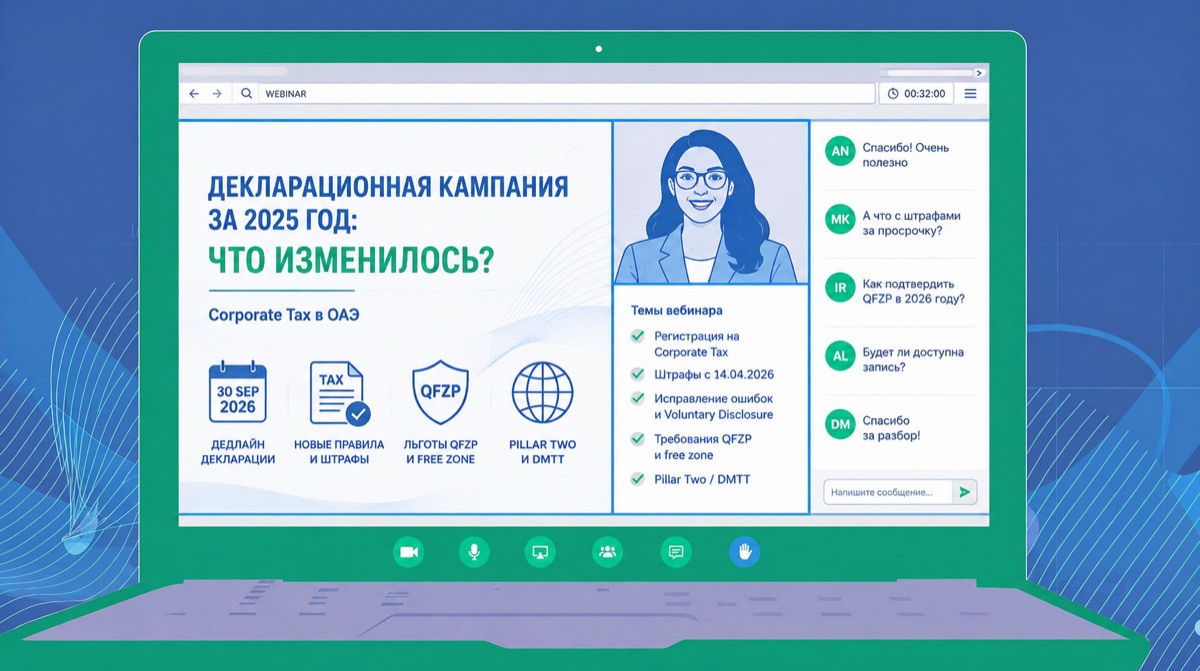
The Corporate Tax return for 2025 must be filed by 30 September 2026 by companies whose tax period is the calendar year. The Corporate Tax due must also be paid by the same date. This year, however, the filing season is taking place under updated rules: penalties and the procedure for correcting errors have changed, the FTA has issued new guidance on QFZPs and Free Zone companies, and Pillar Two / the Domestic Minimum Top-up Tax has come into effect for large multinational groups.
That is why simply repeating last year's return will not work. Before filing the Corporate Tax Return for 2025, businesses should check not only the tax calculation but also the company's tax status, the availability of reliefs, related-party transactions and the new FTA requirements.
We look at what has changed and what businesses in the UAE should check before filing their 2025 return.
Corporate Tax return for 2025: when to file
The general principle remains the same: the Corporate Tax Return must be filed, and the tax paid, within nine months of the end of the relevant tax period.
So for a company with a financial year running from 1 January to 31 December 2025, the deadline for filing the return and paying Corporate Tax is 30 September 2026.
It is important not to confuse this deadline with those of companies using a different financial year: the Corporate Tax Return deadline is determined by the end of the specific Tax Period.
In 2026, the deadline itself is not the only thing that matters. A new administrative penalties regime has applied since 14 April, additional requirements have been introduced for certain Free Zone companies, and large multinational groups need to prepare for separate reporting under Pillar Two.
So before filing the return, it is worth checking not only the final amount of tax but also the company's tax status as a whole.
Does a company need to register for Corporate Tax if it is not trading?
A common mistake is to assume that a company with no activity, turnover or profit is automatically exempt from Corporate Tax.
The absence of income does not in itself remove a legal entity's tax obligations. If a company falls within the scope of Corporate Tax, it must register with the FTA and meet the related obligations even when it is not actually trading.
The problem may only surface much later — for example, when you try to close the company.
To complete a liquidation, the legal entity's tax status must be settled. If the company should have registered for Corporate Tax but did not, it may first need to register, file the required returns and pay any tax liabilities and penalties, and only then complete tax deregistration.
In practice, this creates a chain: no required Corporate Tax registration → tax deregistration cannot be completed properly → problems with Tax Clearance → the company's liquidation may be delayed.
That is why tax status needs to be checked not only by active businesses but also by companies that have already ceased operations and are preparing to close.
What has changed with FTA penalties in 2026
Since 14 April 2026, a new administrative penalties regime for breaches of tax legislation has applied in the UAE.
One of the most notable changes concerns late payment of tax.
Previously, late payment was penalised under a model in which the penalty consisted of an initial charge followed by further increases depending on how long the payment was overdue. Now a rate of 14% per annum, calculated pro rata to the number of days of delay, applies.
This is particularly important for the 2025 filing season: tax due by 30 September 2026 falls entirely under the new regime.
Some other administrative penalties have also changed. For example, the penalty for failing to submit required tax information and documents in Arabic has been reduced from AED 20,000 to AED 5,000.
The new mechanism makes some penalties more proportionate to the length of the breach, but it does not remove liability. The longer a significant amount of Corporate Tax remains unpaid, the higher the eventual cost to the business.
An error in the return: when a Voluntary Disclosure is required
Another important change concerns the correction of errors in tax returns.
Previously, businesses tended to assume that discovering an inaccuracy in a return already filed automatically meant having to submit a Voluntary Disclosure and prepare for additional penalties. The procedure is now more differentiated.
In particular, the size of the tax difference matters. The materiality threshold is AED 10,000.
If an error results in a tax difference of more than AED 10,000, a Voluntary Disclosure must be submitted within the prescribed period after the error is discovered.
For smaller amounts, in certain situations the error can be corrected in a subsequent tax return. Separate rules apply if the company is in the process of deregistration.
In addition, since 14 April 2026, a Voluntary Disclosure that does not change the amount of tax no longer attracts the previous fixed penalty simply for making the correction.
The practical takeaway for businesses is simple: an error that has been discovered should not automatically be ignored for fear of a penalty. First, establish its nature, its effect on the amount of tax and the applicable correction mechanism.
What has changed for Free Zone companies and QFZPs
Registering a company in a Free Zone does not in itself mean that the 0% Corporate Tax rate applies automatically.
To benefit from the preferential regime, the company must meet the requirements for a Qualifying Free Zone Person (QFZP), and its income must meet the conditions for Qualifying Income.
What matters is not only the type of activity and the counterparties, but also the company's economic substance, its employees, assets, operating expenditure, transfer pricing and compliance with the regime's other requirements.
In 2025–2026, the rules and guidance for QFZPs continued to evolve. In particular, certain qualifying activities were clarified, including some treasury activities, dealing in commodities, structured commodity financing and distribution.
For businesses, this means that the classification of a Free Zone company's activities must be reviewed afresh in light of the current rules, rather than automatically carrying over the approach taken in the previous return.
Substance deserves particular attention. Holding a licence and a registered address does not mean that the economic substance requirements have been met. The FTA assesses whether the company has adequate resources to carry out the relevant activities.
A new requirement for some QFZPs in a Designated Zone
A separate change concerns QFZPs that distribute goods or materials through a Designated Zone.
For tax periods beginning on or after 1 January 2026, they face an additional procedure for confirming compliance with the regime's requirements: an independent auditor's agreed-upon procedures report in accordance with ISRS 4400.
Such a review confirms, among other things, the buyers' status as resellers and the actual import of the goods.
This requirement does not yet apply to the return for calendar year 2025. But the companies it affects need to set up processes now and collect supporting documents throughout 2026.
The cost of getting this wrong is particularly high: failure to meet the additional requirement may jeopardise the company's entitlement to the preferential QFZP regime.
Transfer pricing: what to check before filing
Transactions with Related Parties and Connected Persons require particular attention.
UAE transfer pricing rules require such transactions to be conducted on market terms, in line with the arm's length principle. Depending on the nature and volume of transactions, a company may have additional disclosure and documentation obligations.
When preparing the Corporate Tax Return for 2025, it is especially important to check adjustments that reduce taxable income to a market level.
The FTA has clarified how such adjustments must be disclosed, so a single accounting entry may not be enough: you need to check that the transaction is correctly reflected in the tax return itself.
This is particularly relevant for groups of companies where one legal entity provides another with loans, management or administrative services, leases, licences or other intra-group services.
Small Business Relief: the relief is coming to an end
Small businesses should pay separate attention to Small Business Relief.
The regime allows tax relief subject to the established conditions and a revenue threshold of AED 3 million. However, the relief is temporary and applies to relevant tax periods ending no later than 31 December 2026.
For companies currently using Small Business Relief, this means it is already time to plan for when the regime ends.
It is better to prepare your accounting and tax records in advance, so that moving to the standard Corporate Tax regime does not result in an unexpected tax burden or the need to reconstruct documents retrospectively.
Pillar Two is already in effect in the UAE
Another significant change affects large multinational groups.
For financial years beginning on or after 1 January 2025, the UAE applies a Domestic Minimum Top-up Tax (DMTT) — the local implementation of the OECD Pillar Two rules.
The regime applies to multinational groups with consolidated revenue of EUR 750 million or more, if that threshold was exceeded in at least two of the four preceding financial years.
The aim of the mechanism is to ensure a minimum effective tax rate of 15%.
Importantly, the threshold is determined at the level of the entire multinational group. A relatively small company in the UAE may therefore also fall within the scope of Pillar Two if its ultimate parent group meets the criteria.
The rule also applies to Free Zone companies. QFZP status and the 0% rate under standard Corporate Tax do not in themselves take a company outside the potential scope of the DMTT.
Registration for Pillar Two is separate from standard Corporate Tax registration. For calendar-year groups, 2025 is already the first reporting period, and the first Top-up Tax Return must be filed by 30 June 2027.
There is no point in waiting until 2027, though: the group perimeter should be defined, responsibility for reporting allocated and collection of the necessary data started well in advance.
What companies should check before 30 September 2026
Preparing the Corporate Tax Return for 2025 is no longer just about calculating accounting profit and applying the tax rate.
Before filing the return, it is worth checking:
- whether the company is correctly registered with the FTA;
- whether its actual activities match its registration details;
- whether the tax base has been calculated correctly;
- whether there are errors in previously filed returns and whether they need correcting;
- whether related-party transactions are correctly reported;
- whether the transfer pricing requirements have been met;
- whether the Free Zone company retains its entitlement to QFZP status and the 0% rate;
- whether its activities meet the substance requirements;
- whether Small Business Relief is available to the company;
- whether the company belongs to a multinational group within the scope of Pillar Two;
- whether there are overpayments or tax credits that need to be taken into account.
The defining feature of the 2025 filing season is that a significant share of the risks arises not from the Corporate Tax rate itself, but from the classification of transactions, disclosures, compliance with formal requirements and the timely correction of errors.
Free webinar: what has changed in the filing season for 2025
Tax rules are becoming more detailed, and the impact of any particular change depends on the company's structure and activities. That is why some questions cannot be resolved with a generic checklist alone.
Relocate Group held a free webinar, "The 2025 tax return season: what has changed?"
Presented by Mariam Baeva.
The webinar covers in detail:
- who is required to register for Corporate Tax, including where there is no activity or profit;
- why problems with tax registration may come to light when a company is liquidated;
- how penalties have been calculated since 14 April 2026;
- when an error can be corrected without a penalty, and when a Voluntary Disclosure is required;
- which requirements must be met to retain QFZP status;
- which Free Zone activities may be treated as qualifying;
- what has changed in preparing the Corporate Tax Return for 2025;
- how to take transfer pricing into account;
- who is affected by Pillar Two / DMTT and what such groups need to do now.
We pay particular attention to practical situations and the FTA's approach: not just the legal requirements themselves, but also what they mean for businesses in practice.
Watch the webinar for free
The webinar recording is available free of charge on YouTube:
Watch the webinar "The 2025 tax return season: what has changed?"
After watching, you can also put questions about your own situation to Relocate Group's specialists — for example, on the Corporate Tax Return for 2025, correcting errors, QFZPs, Free Zone activities, transfer pricing or Pillar Two.
There is still time before 30 September to review the company's tax position and correct any errors in advance. Do not wait until the last weeks of the filing season to discover that last year's approach no longer complies with the current rules.